AI Careers: Your Guide to the Future of Work and Employment Opportunities

AI careers are no longer limited to people building robots, writing complex algorithms or working in advanced research labs. That version of artificial intelligence still exists, but the career picture has become much wider.
Today, AI is entering banking, retail, healthcare, education, law, marketing, cybersecurity, project management, software development, human resources, finance and operations. Some people will build AI systems. Others will use AI to make better decisions. Some will protect systems from AI-driven threats. Others will lead teams through AI adoption.
That is why the future of work is not only about “AI replacing jobs”. It is also about AI changing the shape of jobs. The people who benefit most will not be the ones who simply know that AI exists. They will be the ones who understand how to use it, question it, manage it, build with it and apply it in real work.
This guide explains the main AI careers, employment opportunities, skills needed and learning routes for 2026, including how Digital Regenesys AI courses can help different types of learners prepare for the AI-driven workplace.
Turn AI Curiosity Into a Real Skill
Learn to build real AI models with Python, hands-on projects & live mentor support.
Explore ProgrammeAI Careers Are Not One Career
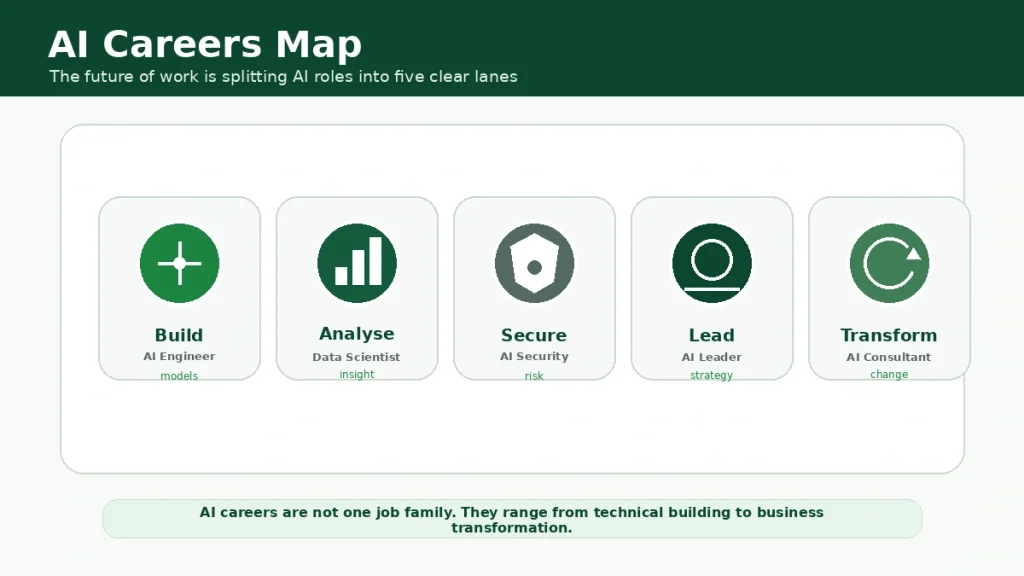
The phrase “AI career” can be misleading because it sounds like there is one path. AI careers sit across several lanes. Some are deeply technical. Some are business-focused. Some are creative. Some are analytical. Some are about governance, risk and ethics.
A machine learning engineer may spend the day building and testing models. A data scientist may use AI to find patterns in customer behaviour. An AI product manager may decide which AI feature a business should build next. An AI transformation lead may help a company redesign processes around automation. A cybersecurity analyst may use AI tools to detect suspicious activity.
All of these are AI careers, but they do not require the same skills.
This is good news. It means learners do not have to become advanced programmers to work with AI. But they do need to choose the right route.
A technical learner may start with Artificial Intelligence. A manager may be better suited to AI Leadership. A professional responsible for organisational change may need AI Transformation.
The right AI career starts with the right question: what role do you want AI to play in your work?
Why AI Careers Matter in the Future of Work
AI is becoming part of how work is planned, automated, analysed and improved. It can write drafts, summarise information, support coding, analyse data, detect patterns, recommend decisions, generate content, monitor risk and automate repetitive processes.
But AI does not remove the need for human judgement. In fact, it increases the need for people who can ask better questions, check outputs, understand risk and connect AI tools to real business problems.
The World Economic Forum Future of Jobs Report 2025 highlights technology as one of the major forces transforming work up to 2030. The Stanford HAI AI Index 2026 also shows how quickly generative AI has spread.
For South Africa, AI skills are becoming part of employability. Microsoft has also reported major AI skilling efforts in the country through its AI Skills Initiative and related partnerships.
This creates two types of opportunity.
- The first is direct AI employment: jobs where AI is the main work.
- The second is AI-enabled employment: jobs where AI makes an existing role more productive, analytical or strategic.
Main AI Career Paths in 2026
AI career paths can be grouped into five broad categories.
1. AI Builder Careers
AI builders create, train, test and improve AI systems.
Possible roles include:
- AI Engineer
- Machine Learning Engineer
- AI Software Developer
- NLP Engineer
- Computer Vision Engineer
- Robotics Engineer
- AI Research Assistant
- Generative AI Developer
These roles usually require stronger technical skills. Learners need programming, mathematics, data, model evaluation and software development foundations.
This is where a course such as Artificial Intelligence becomes useful because it focuses on AI concepts, model building, data preparation and practical AI tools.
AI builder careers are best suited to people who enjoy logic, technical problem-solving and building systems.
2. AI Data Careers
AI depends on data. Data professionals help organisations collect, clean, analyse and interpret information. They may also build models that help predict outcomes or identify patterns.
Possible roles include:
- Data Analyst
- Data Scientist
- Machine Learning Analyst
- BI Developer with AI Focus
- Data Engineer
- Analytics Consultant
- AI Reporting Specialist
These careers are a strong fit for people who enjoy working with numbers, dashboards, patterns and business questions.
A learner who wants to move into this area may consider Data Science with AI or Data Analytics Powered by AI, depending on whether they want a technical data science route or a more business analytics route.
3. AI Security Careers
AI is creating new cybersecurity opportunities. As organisations use AI tools, they need people who can protect data, monitor risks, identify threats and understand how attackers may also use automation.
Possible roles include:
- Cybersecurity Analyst
- AI Security Analyst
- Security Operations Analyst
- Risk and Compliance Technology Specialist
- AI Governance Support Specialist
- Threat Intelligence Analyst
This path is useful for people who enjoy investigation, systems, risk and problem-solving under pressure.
The Cybersecurity with AI course from Digital Regenesys is a relevant pathway for learners who want cybersecurity knowledge connected to AI-supported tools and digital protection.
4. AI Leadership Careers
Not all AI careers are technical. Businesses also need leaders who understand AI well enough to make smart decisions. These professionals do not always build AI systems themselves. Instead, they guide adoption, manage teams, evaluate risks and align AI with business goals.
Possible roles include:
- AI Strategy Manager
- AI Project Sponsor
- AI Product Manager
- AI Adoption Lead
- Digital Transformation Manager
- AI Governance Lead
- Business Innovation Manager
This path is useful for managers, executives, business owners and team leaders. The AI Leadership course is designed for non-technical leaders who need a practical understanding of AI in business, including strategy, governance, ethics and implementation.
This matters because many AI projects fail at the business level, not the technical level. The tool may work, but the organisation may not be ready.
5. AI Transformation Careers
AI transformation careers focus on helping organisations move from AI interest to AI implementation. This includes identifying use cases, redesigning workflows, building roadmaps, training teams and measuring impact.
Possible roles include:
- AI Transformation Consultant
- Business Transformation Lead
- AI Implementation Specialist
- Innovation Consultant
- Operations Improvement Lead
- Digital Change Manager
The AI Transformation course from Digital Regenesys is designed for mid-level and senior professionals who want to guide practical AI adoption in organisations.
This is one of the most important future work areas because many businesses do not only need AI tools. They need people who can help them use those tools properly.
AI Employment Opportunities in South Africa
AI employment opportunities in South Africa are growing across several areas. The strongest opportunities are likely to sit where AI connects to real business problems:
- Software development
- Data science
- Cybersecurity
- Banking and fintech
- Telecommunications
- Retail analytics
- Healthcare systems
- Education technology
- Business intelligence
- Customer experience
- Process automation
- Risk and compliance
- Digital transformation
- Project management
- Marketing technology
Some roles will be labelled clearly as AI jobs. Others may not have “AI” in the title but will still require AI skills.
For example, a marketing analyst may need to use AI tools for segmentation and reporting. A project manager may need AI-supported planning tools. A finance professional may use AI to interpret trends. A cybersecurity analyst may use AI-assisted threat detection.
That is why AI employment is wider than job titles suggest. The future workplace will not only ask, “Can you use AI?” It will ask, “Can you use AI responsibly to improve the work?”
Entry-Level AI Careers
Entry-level AI careers can be challenging because many AI roles require a mix of data, coding, mathematics and practical project experience. But entry-level does not mean impossible.
Good starting roles may include:
- Junior Data Analyst
- Junior AI Engineer
- AI Support Assistant
- Junior Software Developer
- QA Tester with AI Tools
- BI Assistant
- Automation Assistant
- Junior Machine Learning Analyst
- IT Support Analyst with AI Exposure
- AI Research Assistant
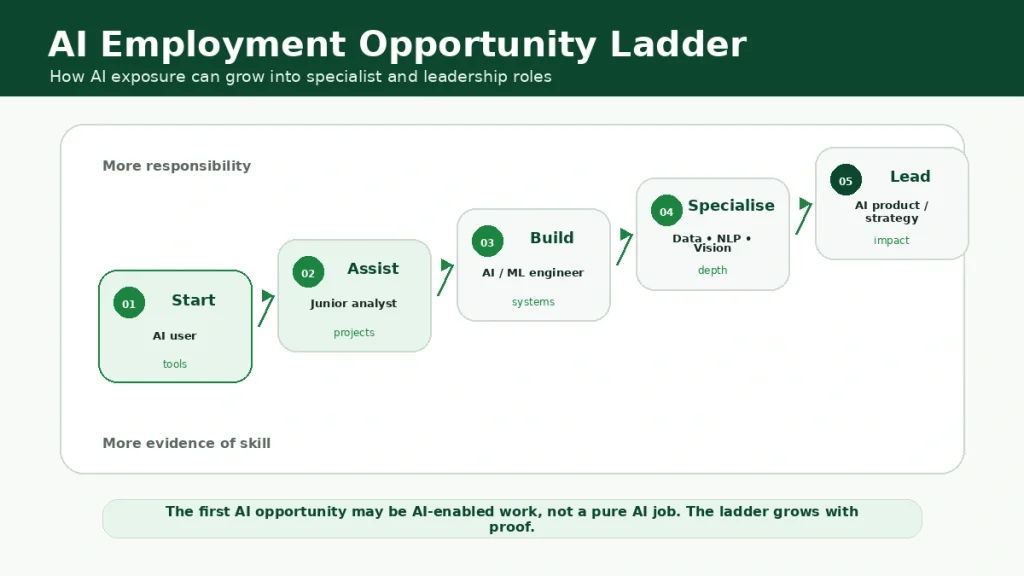
For beginners, the aim should be to build proof. That proof can include small projects, notebooks, dashboards, AI workflows, automation scripts, simple models or case-study write-ups.
A certificate helps, but evidence of work helps more. This is why learners should choose courses that include practical tasks, capstone projects or portfolio-building opportunities.
AI Careers for Non-Technical Professionals
One of the biggest myths about AI careers is that they are only for coders. They are not. Non-technical professionals can build AI-enabled careers by learning how AI affects their function.
For example:
- HR professionals can use AI in workforce planning and talent analytics.
- Marketers can use AI in content planning, campaign analysis and customer segmentation.
- Finance professionals can use AI for forecasting, reporting and risk monitoring.
- Project managers can use AI for scheduling, risk tracking and status reporting.
- Business owners can use AI to automate repetitive work and improve customer service.
- Executives can use AI for strategy, governance and business model innovation.
This is where AI Leadership, AI Transformation, Project Management Powered by AI and Data Analytics Powered by AI are useful.
The goal is not to turn every professional into a programmer. The goal is to help professionals become better at their work because they understand AI.
Skills Needed for AI Careers
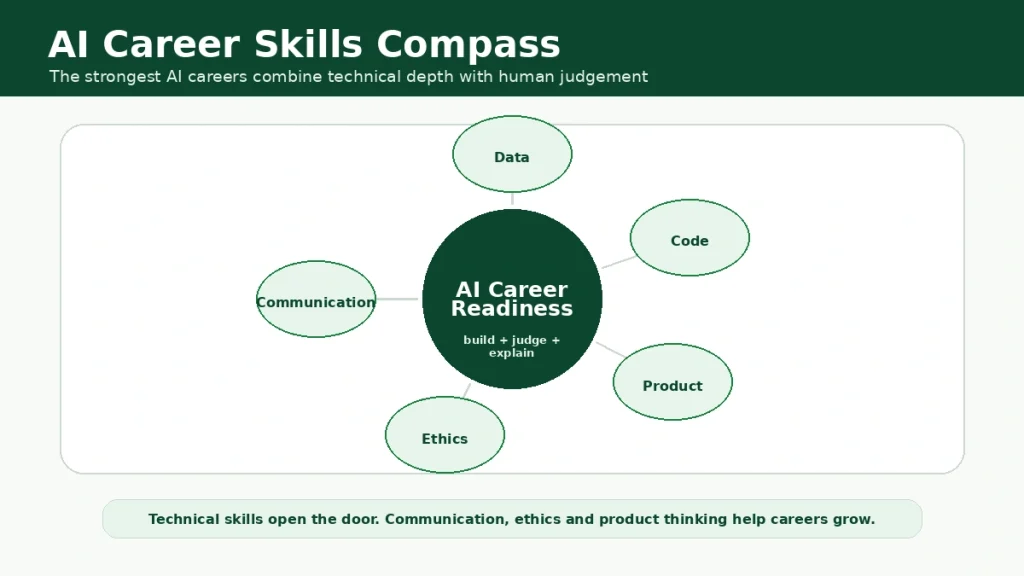
AI careers need a combination of technical and human skills.
The technical skills may include:
- Python
- Data analysis
- SQL
- Machine learning
- Statistics
- Prompting
- Software development
- Cloud basics
- Cybersecurity awareness
- Model evaluation
- Automation tools
- Data visualisation
The human and business skills are just as important:
- Communication
- Critical thinking
- Ethical judgement
- Curiosity
- Problem-solving
- Business understanding
- Collaboration
- Change management
- Ability to explain technical ideas simply
This combination matters because AI work is rarely isolated. An AI engineer may need to explain a model to a manager. A business leader may need to ask the right questions before approving an AI project. A data analyst may need to turn a prediction into a clear recommendation. The future of AI work belongs to people who can build, judge and explain.
How to Start an AI Career
A beginner should not try to learn everything at once. Start with your lane.
- If you want to build AI systems, learn AI fundamentals, Python, machine learning and data preparation through a course such as Artificial Intelligence.
- If you want to work with data, start with Data Science with AI or Data Analytics Powered by AI.
- If you are a manager or business owner, start with AI Leadership.
- If your company is trying to adopt AI, consider AI Transformation.
- If you want to build applications, consider Full Stack Development with AI.
- If you want to protect digital systems, consider Cybersecurity with AI.
After choosing a lane, build evidence.
Do a project. Write up what you did. Show the tool, the process, the result and the lesson. That is how AI learning becomes employability.
Will AI Replace Jobs?
AI will replace some tasks, change many jobs and create new types of work. That is the honest answer. Routine tasks are more exposed. Work that involves repetitive writing, basic analysis, simple coding, standard reporting and predictable administration may change quickly.
But work that needs judgement, trust, creativity, responsibility, human understanding and context will still need people.
The better question is not, “Will AI take my job?” The better question is, “Which parts of my job can AI change, and what new value can I add?”
People who learn AI early can reposition themselves. They can become the person who improves workflows, checks AI output, trains colleagues, builds automation, manages risk or connects AI tools to business results. That is the opportunity.
Why Digital Regenesys AI Courses Are Useful for Career Growth
Digital Regenesys offers AI courses for different learners, which is important because AI is not one skill.
- The Artificial Intelligence course is useful for learners who want technical AI knowledge.
- The AI Leadership course is useful for managers and decision-makers.
- The AI Transformation course is useful for professionals leading AI adoption in organisations.
The wider Digital Regenesys course range also connects AI to practical career areas, including data science, cybersecurity, project management, full stack development and data analytics.
This matters because AI skills become more powerful when they are attached to a role.
- AI plus data can lead to analytics and machine learning opportunities.
- AI plus software can lead to product and development opportunities.
- AI plus cybersecurity can lead to risk and protection opportunities.
- AI plus leadership can lead to strategy and transformation opportunities.
That is the real career value.
Next AI Batch Starts Soon
Join 500,000+ alumni. Live classes, real projects, IITPSA-accredited certificate.
Enrol NowAI Careers Will Reward People Who Can Adapt Faster Than Their Job Descriptions
The future of work will not be shaped by AI alone. It will be shaped by people who know how to use AI well. Some jobs will become more technical. Some will become more analytical. Some will become more strategic. Some will be redesigned completely. But across industries, one thing is clear: AI skills are becoming part of career resilience. The best AI career path is not always the most technical one. It is the one that helps you become more valuable in the work you want to do.
For learners who want to prepare for that future, Digital Regenesys offers practical AI pathways including Artificial Intelligence, AI Leadership, AI Transformation, Data Science with AI, Full Stack Development with AI and Cybersecurity with AI.
The opportunity is not only to get an AI job. It is to become the kind of professional who can work better because AI exists.
Last Updated: 20 July 2026