Best Cybersecurity Courses & Certificates in 2026

The best cybersecurity course in 2026 is not the one that throws the most technical terms at you. It is the one that helps you understand how digital systems are attacked, how risks are detected, how organisations respond, and how security work actually happens in the real world.
Cybersecurity has moved far beyond passwords and antivirus software. It now sits at the centre of business continuity, cloud infrastructure, AI adoption, data protection, fraud prevention and customer trust. Every organisation that uses digital tools has security exposure. That means cybersecurity skills are no longer only for specialised security teams. They are becoming useful for IT professionals, managers, developers, analysts, cloud learners and even non-technical decision-makers.
But the course you choose matters. A beginner does not need the same certificate as an experienced security engineer. A manager does not need the same course as someone trying to become a SOC analyst. A developer may need application security. A cloud learner may need cloud security. A risk professional may need governance and compliance.
This guide compares the best cybersecurity courses and certificates for 2026, including practical online options, entry-level certificates, AI-focused cybersecurity learning and how to choose the right route for your career.

Why Cybersecurity Certificates Matter in 2026
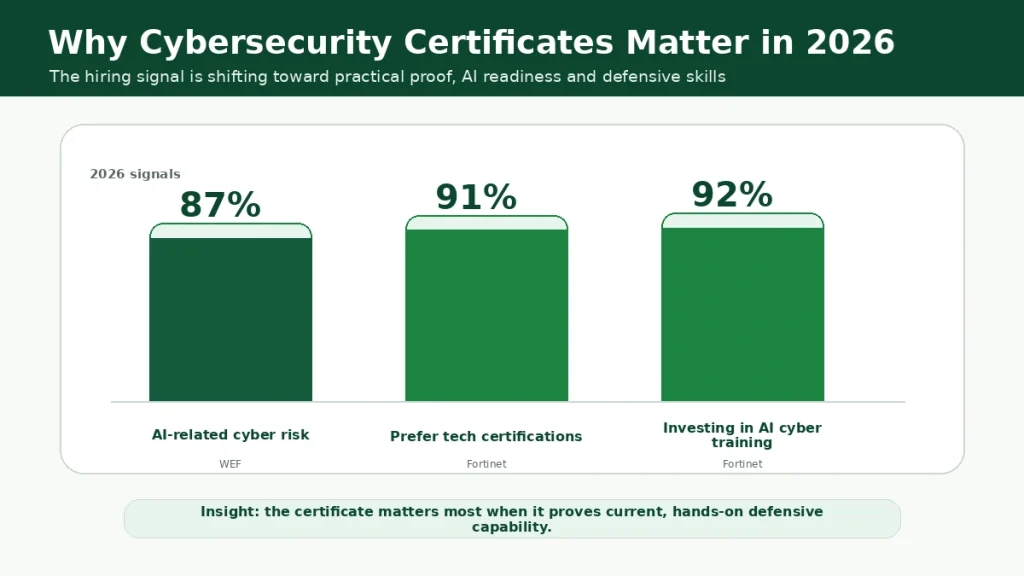
Cybersecurity certificates matter because employers need proof that a learner understands current risks, tools and defensive practices. That does not mean a certificate alone will get you a job. It will not. But a certificate can help open the conversation, especially when it is backed by practical work, labs, projects and tool exposure.
This is important because the threat environment is changing quickly. The World Economic Forum Global Cybersecurity Outlook 2026 highlights AI-related vulnerabilities, data leaks linked to generative AI, fraud and phishing as major areas of concern. The Fortinet 2026 Cybersecurity Skills Gap Report also shows that employers continue to value certifications when hiring.
This tells us something useful. Cybersecurity is not only short of people. It is short of people who can prove useful, current and practical security capability. That is where the right course becomes valuable.
Best Overall Practical Course: Cybersecurity with AI
For learners who want a practical online course with a certificate, the Cybersecurity with AI course from Digital Regenesys is one of the strongest options to consider.
It is a 6-month live online course designed for people who want to learn cybersecurity fundamentals and build practical skills at a steady pace. The course covers security operations, risk assessment, network security, ethical security principles, incident handling, malware behaviour, monitoring and AI-enabled security practice.
It includes:
- 96 hours of learning content
- 48 live sessions
- 28 tools and languages
- 30 CPD points
- IITPSA-accredited certification
- Guided practice
- Capstone projects
- Practical exposure to common cybersecurity tools
This makes it useful for beginners, early-career professionals, working adults, IT professionals, managers and people who want to enter cybersecurity without feeling lost in highly advanced theory too early.
The biggest strength of this route is that it connects cybersecurity with AI. That matters because security teams now need to understand both sides of AI: how AI can help detect threats and how AI can create new risks.
If you want a structured, practical and career-focused online course, Digital Regenesys Cybersecurity with AI is a strong starting point.
Best Beginner Certificate: ISC2 Certified in Cybersecurity
For people who want an internationally recognised entry-level cybersecurity certificate, ISC2 Certified in Cybersecurity is worth considering. It is designed for people entering cybersecurity or moving from another profession. It validates core security concepts and can help beginners understand the language of the field.
This is a good option if you want to show that you understand foundational cybersecurity ideas such as security principles, access control, risk, network security and incident response.
However, learners should be realistic. A beginner certificate helps you start. It does not make you a cybersecurity expert. To become job-ready, you still need practical labs, projects, tool exposure and the ability to explain what you have learned.
That is why a course such as Digital Regenesys Cybersecurity with AI can work well alongside an entry-level certification pathway. One gives structure and practice. The other can add global credential value.
Best Foundational Industry Certificate: CompTIA Security+
CompTIA Security+ is one of the most recognised foundational cybersecurity certifications globally. It is often chosen by learners who want vendor-neutral cybersecurity knowledge. Vendor-neutral means the learning is not tied to only one company’s tool or platform. That makes it useful for people who want broad security foundations before specialising.
Security+ is usually relevant for people interested in roles such as junior security analyst, IT support with security responsibilities, systems administrator, help desk technician, network support professional or entry-level cybersecurity learner.
It can help learners understand areas such as threats, vulnerabilities, architecture, operations, security controls and risk.
But again, the certificate works best when paired with practice. Cybersecurity is not a field where memorising definitions is enough. You need to understand how threats appear in systems, how controls reduce risk and how security decisions affect real organisations.
Best SOC-Focused Route: Cisco CyberOps Associate
If your goal is to work in a security operations centre, commonly called a SOC, then a SOC-focused route is useful. A SOC is where teams monitor threats, investigate alerts and respond to incidents. This type of work needs attention to detail, tool familiarity, log analysis, alert triage and calm thinking under pressure.
The Cisco CyberOps Associate pathway is relevant for learners interested in monitoring, detecting and responding to cyber threats. It can be useful for people aiming at roles such as SOC Analyst, Cybersecurity Analyst, Security Operations Analyst or Incident Response Assistant.
The Digital Regenesys Cybersecurity with AI course also supports this direction because it covers threat detection, monitoring, network security, SOC and EDR platforms, vulnerability assessment and AI-enabled SOC concepts.
For SOC work, your certificate should not only show theory. It should help you become comfortable with alerts, logs, tools and defensive thinking.
Best AI-Focused Cybersecurity Route
AI is changing cybersecurity in two ways. Defenders are using AI to improve detection, prioritise risks and reduce alert overload. Attackers can also use AI to scale phishing, automate reconnaissance and generate more convincing social engineering attempts. That is why AI-focused cybersecurity learning is becoming more important.
WEF’s 2026 outlook highlights AI-related vulnerabilities and generative AI data leakage as major risk areas. The Fortinet skills gap report also shows strong employer interest in AI-related cybersecurity training and certifications.
This makes Cybersecurity with AI particularly relevant. It helps learners understand cybersecurity fundamentals while also building awareness of AI-enabled security operations.
This route is useful for:
- IT professionals who want AI security awareness
- Beginners entering cybersecurity in 2026
- Managers who need to understand cyber risk
- Analysts who want to learn AI-supported security workflows
- Professionals who want a modern security certificate
AI security will not be a separate niche forever. It is becoming part of normal cybersecurity work.
Best Cybersecurity Course for Managers and Risk Professionals
Not everyone studying cybersecurity wants to become a technical analyst. Managers, business owners, compliance professionals and team leaders may need cybersecurity knowledge because they are responsible for decisions, policies, vendors, staff training, budgets or business continuity.
For these learners, the best course is one that explains cyber risk clearly and connects it to organisational decisions.
A manager should understand:
- What cyber risk means
- Why phishing and fraud matter
- How data leaks happen
- Why access control is important
- What incident response requires
- How AI changes security exposure
- Why training and governance matter
- How to ask the right questions before approving tools
The NICE Cybersecurity Workforce Framework is useful here because it shows how broad cybersecurity work really is. Cybersecurity is not only technical operations. It also includes governance, risk, compliance, training, planning and management.
For managers, Digital Regenesys Cybersecurity with AI can be a practical entry point because it introduces security operations, risk assessment and organisational cyber defence without requiring learners to already be advanced security engineers.
Best Cybersecurity Learning Path for Developers
Developers should not treat cybersecurity as someone else’s job. Software security is now part of responsible development. Weak authentication, insecure APIs, poor data handling, unsafe dependencies and rushed releases can expose users and businesses to serious risk.
A developer-focused cybersecurity path should include secure coding principles, web application security, authentication, API security, vulnerability awareness, testing and secure deployment practices.
For learners in software development, cybersecurity pairs well with Full Stack Development with AI, because developers who understand security can build safer applications.
A developer does not need to become a full-time penetration tester to benefit from cybersecurity. They need to understand how to avoid common mistakes and how to work better with security teams.
Best Cybersecurity Learning Path for Cloud and DevOps
Cloud and DevOps professionals need cybersecurity because modern systems are built, deployed and scaled through cloud platforms and automated pipelines.
A cloud security learner should understand:
- Identity and access management
- Cloud misconfiguration risks
- Network security
- Container security
- CI/CD pipeline security
- Infrastructure as code risks
- Monitoring and logging
- Incident response
- Cloud cost and security trade-offs
This is where cybersecurity connects naturally with DevOps and Cloud Computing with AI. As more organisations move to cloud and AI-supported delivery, security becomes part of infrastructure, automation and operations.
In 2026, the best cybersecurity professionals will not only protect devices. They will protect cloud environments, workflows, data and automated systems.
How to Choose the Best Cybersecurity Course
Start with your goal.
- If you are a beginner, choose a course that gives you fundamentals, tools and guided practice.
- If you want a certificate for your CV, choose one that is recognised and relevant to the job level you want.
- If you want a SOC role, prioritise monitoring, threat detection, incident response and practical tools.
- If you are a developer, prioritise application security.
- If you work in cloud, prioritise cloud security and infrastructure risk.
- If you are a manager, prioritise cyber risk, governance and AI-related security exposure.
- If you want a modern practical route, choose a programme that includes AI, because cybersecurity is increasingly shaped by AI-related risks and AI-supported defence.
The best choice is not always the most advanced course. It is the course that fits your current level and gives you credible proof of skill.
What a Good Cybersecurity Certificate Should Prove
A good cybersecurity certificate should prove more than attendance.
It should show that you understand:
- Common cyber threats
- Network security basics
- Risk assessment
- Vulnerability thinking
- Incident handling
- Malware behaviour
- Security tools
- Defensive monitoring
- Data protection
- AI-related risks
- Ethical and responsible security practice
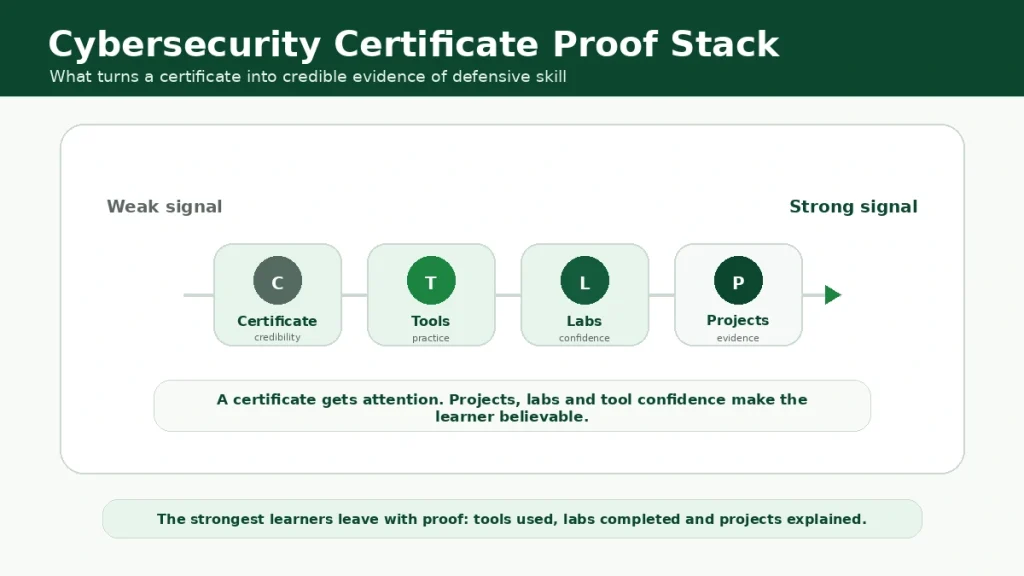
It should also help you produce proof, such as projects, lab work, tool experience or case-based exercises.
The Digital Regenesys Cybersecurity with AI course includes guided practice, practical exercises and capstone projects, which is important because employers want evidence of skill. A certificate gets attention. Practical proof builds trust.
Cybersecurity Jobs After a Course or Certificate
Cybersecurity career paths can vary depending on your background and experience.
Possible roles include:
- SOC Analyst
- Junior Cybersecurity Analyst
- Security Operations Analyst
- Incident Response Assistant
- IT Security Support
- Cybersecurity Technician
- Risk and Compliance Assistant
- Security Auditor
- Cloud Security Assistant
- Vulnerability Assessment Assistant
- Network Security Analyst
- Cybersecurity Consultant
- Security Engineer
- Penetration Testing Assistant
- Malware Analyst
- Security Architect
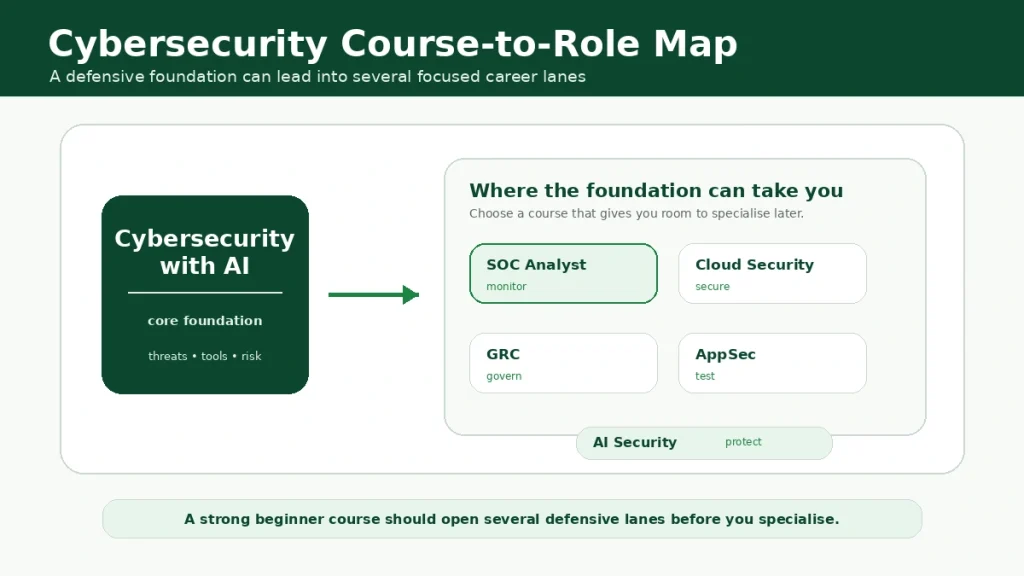
The Digital Regenesys Cybersecurity with AI page lists career paths such as SOC Analyst, Security Engineer, Penetration Tester, Malware Analyst, Security Auditor, Security Architect, Security Consultant and Incident Responder.
For beginners, the most realistic first step is usually not a senior security role. It may be a junior analyst, IT support role with security exposure, SOC assistant role or compliance support role.
That is normal. Cybersecurity careers grow through practice, experience and trust.
Turn Data Skills Into Career Growth
Learn Python, machine learning & Power BI with hands-on, AI-enabled projects.
Explore ProgrammeIs Cybersecurity a Good Career in 2026?
Yes, cybersecurity remains a strong career direction in 2026. The reason is simple: digital risk keeps expanding.
AI, cloud systems, remote work, mobile apps, online payments, business platforms, customer data and connected devices all increase the need for security skills.
The ISC2 Cybersecurity Workforce Study shows that cybersecurity teams continue to operate under pressure from budget constraints, staffing challenges and changing organisational needs. That means employers need people who can contribute practically, not only people with theoretical knowledge.
Cybersecurity is also a field where continuous learning matters. Tools change. Threats change. Regulations change. AI changes the risk landscape. A good course gets you started. A strong career depends on staying current.
What Skills Should You Build Alongside a Certificate?
The strongest cybersecurity learners build skills alongside the certificate.
Important skills include:
- Networking basics
- Linux basics
- Security tools
- Threat detection
- Vulnerability assessment
- Incident response
- Cloud security awareness
- Risk thinking
- Documentation
- Communication
- Ethical judgement
- AI security awareness
Communication matters more than many beginners realise. Security professionals often need to explain risk to people who are not technical. They need to write clear reports, document incidents, ask good questions and help teams understand what needs to change.
Cybersecurity is not only technical defence. It is also communication under pressure.
Common Mistakes to Avoid
- The first mistake is choosing a course only because it sounds advanced.
- The second mistake is chasing certificates without building practical proof.
- The third mistake is ignoring networking fundamentals.
- The fourth mistake is treating cybersecurity as “hacking” instead of defence, risk and protection.
- The fifth mistake is skipping ethical boundaries.
- The sixth mistake is ignoring AI-related risks.
- The seventh mistake is expecting one certificate to replace experience.
- The eighth mistake is not building a portfolio of labs, notes and projects.
The best cybersecurity learners do not only ask, “What certificate should I get?” They ask, “What can I prove I know how to do?”

Next Data Science Batch Starts Soon
Join 500,000+ alumni. Real projects, AI workflows, IITPSA-accredited certificate.
Enrol NowThe Best Cybersecurity Certificate Should Help You Defend, Not Just Decorate Your CV
A cybersecurity certificate should not be a trophy. It should be evidence that you understand digital risk and can begin contributing to defensive work. The best courses in 2026 are the ones that combine foundations, tools, ethical practice, AI awareness and practical proof. They help learners understand how threats work without losing sight of the real purpose of cybersecurity: protecting people, systems, data and organisations.
For beginners and working professionals who want a practical online route, Cybersecurity with AI from Digital Regenesys offers a strong pathway into cybersecurity skills, live learning, tools, capstone projects and an IITPSA-accredited certificate.
The smartest move is not to chase the most intimidating certificate. It is to choose the course that helps you build real defensive capability, then prove it.
Last Updated: 17 July 2026