Data Science Online Courses in 2026 with Certificates

A data science certificate can look impressive on a CV, but in 2026 the certificate itself is not the real prize. The real prize is what you can do with data after you earn it.
Can you clean a messy dataset? Can you use Python without panicking? Can you build a simple model and explain what it means? Can you turn numbers into a dashboard that helps a manager make a decision? Can you use AI tools without blindly trusting every answer they give you? That is the difference between collecting certificates and building a career skill.
Data science online courses in 2026 are more accessible than ever. There are short certificates, live online programmes, self-paced courses, occupational certificates and postgraduate diplomas. Some are designed for beginners. Some are for working professionals. Some focus on tools. Others focus on deeper statistics, machine learning and research.
The challenge is not finding a course. The challenge is choosing the right course for your current level, your career goal and the kind of proof you want to show after completing it.
What Is a Data Science Online Course?
A data science online course teaches learners how to work with data using digital tools, programming, statistics, visualisation and machine learning.
Most online data science courses cover some combination of:
- Python
- Excel
- SQL
- Data cleaning
- Data analysis
- Statistics
- Data visualisation
- Business intelligence tools
- Machine learning
- AI-supported analysis
- Dashboards
- Project work
- Data storytelling
The “online” part refers to the delivery format. Learning may happen through live virtual classes, recorded videos, guided assignments, dashboards, coding notebooks, quizzes, readings, projects or a learning management system.
The “certificate” part usually means learners receive proof of completion after meeting the course requirements.
But this is where learners must pay attention. A certificate of completion is not always the same as a registered qualification. A short online certificate can still be valuable, but it does not carry the same academic weight as a postgraduate diploma or occupational certificate.
That does not make one better than the other. It means they serve different purposes.
Why Data Science Certificates Matter in 2026
Data is no longer only for data scientists. Marketing teams use data to understand customers. Finance teams use data to track performance and risk. HR teams use data to study retention and skills. Operations teams use data to improve efficiency. Executives use dashboards to make faster decisions. AI tools now make data work more accessible, but they also make strong judgement more important.
This is why a data science certificate can matter. It signals that you have taken time to build practical data skills. More importantly, it can help you produce portfolio evidence, such as dashboards, notebooks, data cleaning exercises, models or case-study projects.
The World Economic Forum’s Future of Jobs Report 2025 shows that technological change, economic uncertainty and other major shifts are reshaping jobs and skills up to 2030. In South Africa, Microsoft has also announced plans to provide AI and cybersecurity training opportunities to one million people by 2026, showing how important digital skills have become locally.
For learners, the message is clear: data skills are becoming part of many career paths, not only technical ones.
The Main Types of Data Science Online Courses
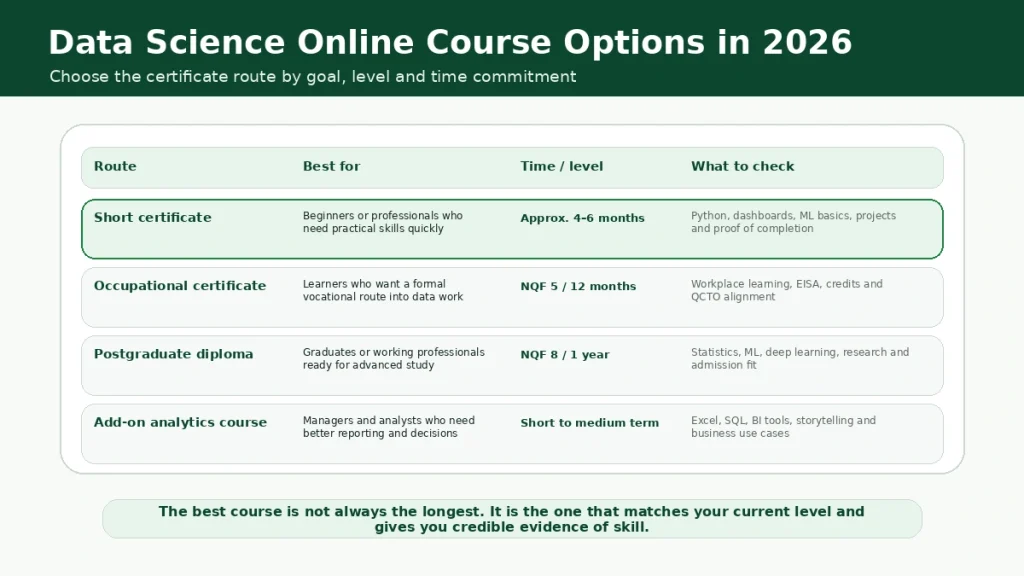
Not all data science courses are designed for the same person. Before enrolling, you need to understand the main course types.
Short Data Science Certificate Courses
A short certificate course is usually best for beginners or working professionals who want practical skills quickly.
This type of course can help you learn the basics of Python, dashboards, data analysis, machine learning and data visualisation without committing to a full qualification.
The Data Science with AI course from Digital Regenesys is an example of this type of pathway. It is designed for online learning and covers practical skills such as Python, data visualisation, data manipulation, Power BI, machine learning and project deployment.
This route is useful if your goal is to upskill, improve workplace performance or build a practical foundation before deciding whether to pursue deeper study later.
Data Analytics Certificate Courses
Data analytics is slightly different from data science. Data analytics is often more focused on reporting, dashboards, business insights and decision support. Data science usually goes deeper into programming, statistics, machine learning and predictive modelling.
If you work in business, marketing, finance, HR, operations or management, a Data Analytics Powered by AI course may be enough to help you make better decisions with data.
If you want to move closer to machine learning, predictive analytics or technical data roles, data science may be the stronger route.
Occupational Certificates
An occupational certificate is more formal and vocational. The Occupational Certificate: Data Science Practitioner from Regenesys Skills Academy is listed as an NQF Level 5 qualification with 185 credits and a 12-month duration. It is designed to prepare learners to support the data science life cycle by collecting, transforming, analysing and communicating data.
This route is useful for learners who want a structured occupational pathway with workplace-based learning and formal assessment.
Postgraduate Data Science Programmes
A postgraduate diploma is for learners who already have a degree or equivalent qualification and want more advanced data science study.
The Postgraduate Diploma in Data Science from Regenesys School of Technology is a one-year online programme designed for working professionals and graduates who want to refine data analysis, computational and machine learning skills.
This route is not the same as a short course. It usually requires stronger academic readiness and is better suited to learners who want deeper career progression in data-driven roles.
Data Science with AI: What Should a Good Course Cover?
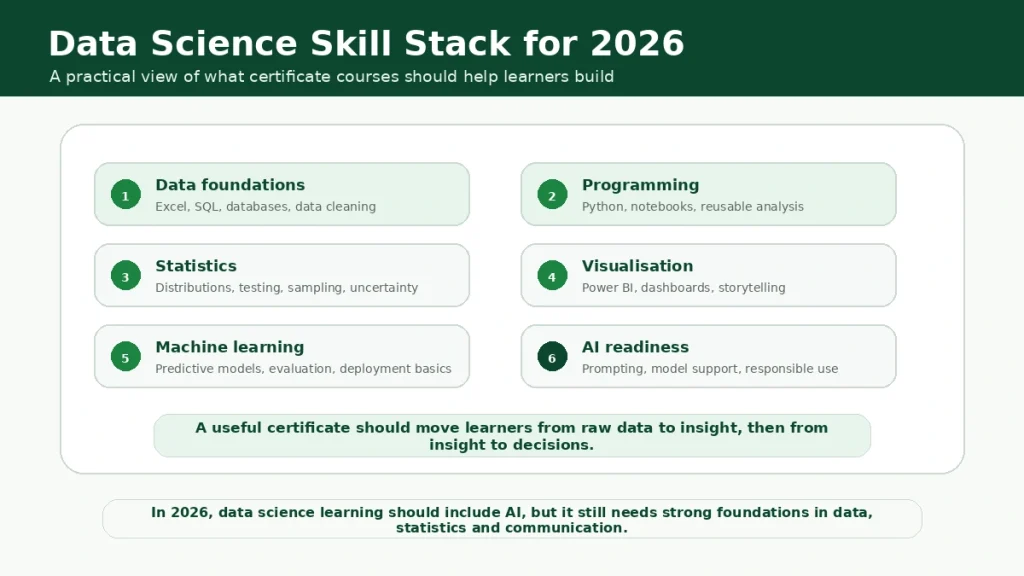
A strong data science online course in 2026 should not only teach isolated tools. It should help learners move through a full data journey.
- First, learners need foundations. This includes Python, spreadsheets, SQL, databases and basic data structures.
- Second, learners need analysis. They should understand how to clean data, explore patterns, ask useful questions and interpret results.
- Third, learners need visualisation. A good data science learner should be able to create charts, dashboards and reports that make sense to non-technical people.
- Fourth, learners need machine learning basics. This includes predictive modelling, evaluation and understanding when a model is useful or misleading.
- Fifth, learners need AI readiness. AI tools can support data science, but learners must know how to check outputs, protect data quality and avoid lazy analysis.
- Finally, learners need a project. A certificate is much stronger when it is supported by something the learner can show.
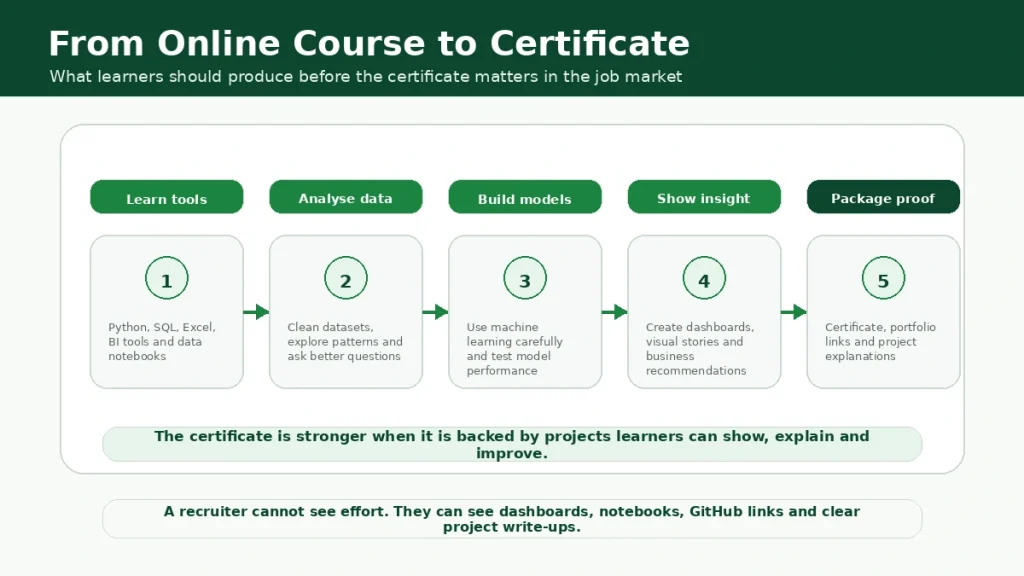
That is why project work matters. A recruiter or manager cannot see your effort. They can see a dashboard, notebook, model summary or project write-up.
What Tools Should You Learn?
The best data science tools depend on the course and career goal, but several tools and skills appear regularly in practical programmes.
Important tools and skills include:
- Python
- SQL
- Excel
- Power BI
- Tableau
- MySQL
- MongoDB
- Jupyter notebooks
- Data cleaning
- Data visualisation
- Machine learning
- Dashboard design
- Business storytelling
The Digital Regenesys Data Science with AI course includes Python programming foundations, applied Python, data exploration, Power BI, machine learning for predictive analytics and data science project deployment.
This combination matters because learners need more than one skill. Python helps with analysis and automation. SQL helps with databases. Power BI helps with dashboards. Machine learning helps with prediction. Data storytelling helps people understand what the analysis means.
A good data science professional does not only produce results. They help other people use those results.
How Long Does a Data Science Online Course Take?
Duration depends on the type of course. A short data science certificate may take a few weeks to a few months. Digital Regenesys lists Data Science with AI as a 24-week course, which is about six months.
A data analytics course may be shorter or more focused, depending on the structure.
An occupational certificate may take around 12 months, especially if it includes formal modules, workplace learning and external assessment.
A postgraduate diploma in data science can take one year.
The right duration depends on your goal.
- If you want practical skills quickly, a certificate course may fit.
- If you want a more formal occupational route, a 12-month occupational certificate may make sense.
- If you already have a degree and want deeper study, a postgraduate diploma may be more appropriate.
Do not choose only by speed. Choose by outcome.
Are Online Data Science Certificates Worth It?
Yes, an online data science certificate can be worth it when it gives you practical skills and proof of work.
It may be worth it if you want to:
- Learn data science basics
- Improve your current role with data skills
- Move from reporting to analysis
- Build Python and dashboard confidence
- Explore machine learning
- Add a certificate to your CV
- Prepare for a data analyst or junior data role
- Build a portfolio before applying for jobs
- Decide whether deeper study is right for you
It may not be worth it if you expect the certificate alone to get you a job. A certificate is a signal. Your skill is the substance.
Employers want to know what you can do. That means your certificate should be supported by projects, examples and clear explanations of your work.
Turn Data Skills Into Career Growth
Learn Python, machine learning & Power BI with hands-on, AI-enabled projects.
Explore ProgrammeData Science Careers After an Online Course
A short certificate may not automatically qualify you for every data science role, but it can help you build skills for data-adjacent and entry-level opportunities.
Possible career directions include:
- Data Analyst
- Junior Data Analyst
- Business Analyst
- Reporting Analyst
- BI Assistant
- Dashboard Developer
- Junior Data Science Assistant
- Marketing Analyst
- Operations Analyst
- Data Science Practitioner
- Machine Learning Assistant
- Analytics Consultant
- Data Visualisation Specialist
The role you can pursue depends on your background.
Someone with business experience may use data science to become a stronger analyst or manager. Someone with programming knowledge may move faster into technical data roles. Someone with a degree in mathematics, statistics, computer science or engineering may use a postgraduate diploma to deepen their data science direction. There is no single path.
That is one reason data science is attractive. It can support different careers, from technical roles to business decision-making.
Data Science vs Data Analytics: Which Course Should You Choose?
- Choose data analytics if your main goal is better reporting, dashboards and business decision-making.
- Choose data science if your goal includes programming, machine learning, predictive modelling and deeper technical analysis.
- Data analytics is often the better starting point for managers, marketers, finance professionals and business users who want to work smarter with data.
- Data science is often better for learners who want a stronger technical path.
That said, the two overlap. Many people start with data analytics and later move into data science. Others start with data science and later specialise in business intelligence, AI or machine learning.
The best route depends on your current level. If you have never worked with data before, do not rush into advanced machine learning. Build foundations first.
How to Choose the Best Data Science Online Course in 2026
Before enrolling, ask these questions:
1. What Certificate Will I Receive?
Check whether it is a certificate of completion, occupational certificate or academic qualification. These are not the same.
2. What Tools Are Covered?
A practical course should include tools you can apply, such as Python, SQL, Excel, Power BI or machine learning tools.
3. Is There Project Work?
Projects are essential. They help you show what you can do.
4. Is the Course Beginner-Friendly?
Do not choose an advanced course if you do not yet understand spreadsheets, logic, statistics or basic programming.
5. Does It Include AI?
In 2026, AI-supported analysis matters. But AI should support the course, not replace learning.
6. Can I Study Online Properly?
You need time, a device, internet access and discipline.
7. Does the Course Fit My Career Goal?
A manager, beginner, graduate and aspiring data scientist may need different courses.
Common Mistakes to Avoid
- The first mistake is choosing a course only because it promises a certificate.
- The second mistake is skipping the basics. Python and machine learning are useful, but statistics, data cleaning and interpretation matter just as much.
- The third mistake is ignoring projects. Without projects, the certificate becomes harder to prove.
- The fourth mistake is thinking AI will do the work for you. AI can assist, but you still need judgement.
- The fifth mistake is choosing a course that does not match your level. A beginner-friendly certificate, occupational certificate and postgraduate diploma are not interchangeable.
The best learners choose the route that fits where they are now, then build from there.
Next Data Science Batch Starts Soon
Join 500,000+ alumni. Real projects, AI workflows, IITPSA-accredited certificate.
Enrol NowThe Right Certificate Should Prove More Than Attendance
A data science online course in 2026 should not only help you collect a certificate. It should help you build proof. Proof that you can work with data. Proof that you can use tools. Proof that you can explain findings. Proof that you can connect analysis to decisions. Proof that you understand AI as a support tool, not a shortcut.
That is what makes a certificate valuable. The best course is not always the longest, shortest or most expensive. It is the one that matches your current level and gives you something real to show at the end.
For learners who want a practical online route into data skills, Data Science with AI from Digital Regenesys offers a certificate-focused pathway covering Python, data visualisation, machine learning, Power BI and applied project work.
Last Updated: 15 July 2026