The Future of DevOps with AI Integration

DevOps has always been about one big idea: make software delivery faster, safer and more reliable by bringing development and operations closer together. AI does not change that goal; it changes how teams reach it.
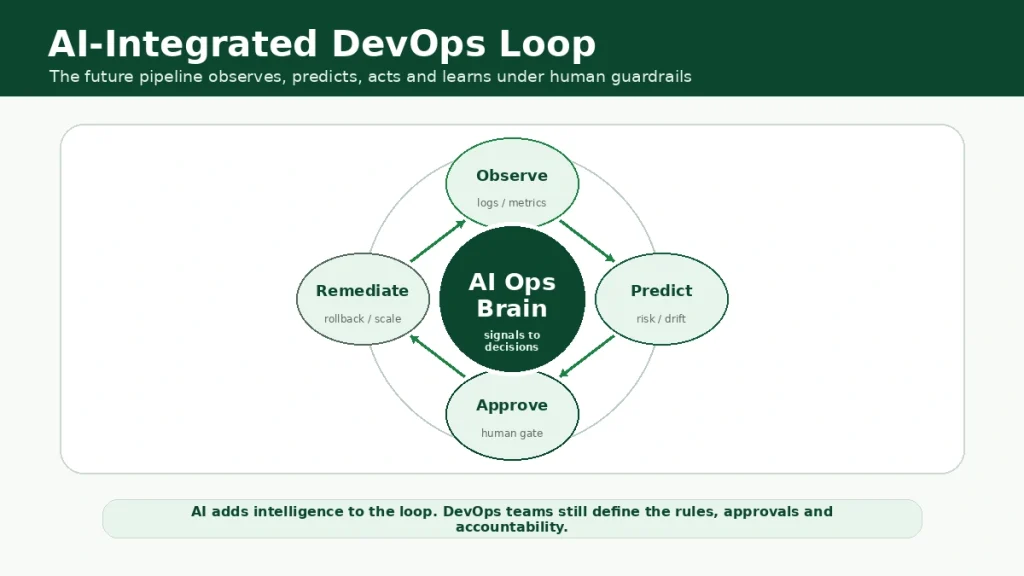
The future of DevOps with AI integration is not simply about adding a chatbot to a pipeline or letting an AI tool write deployment scripts. It is about building smarter software delivery systems that can observe what is happening, detect risks earlier, recommend actions, reduce repetitive work and help teams respond before small issues become production failures.
That sounds powerful, but it also comes with a warning. AI can make DevOps faster. It can also make bad processes fail faster. If a team already has poor testing, unclear ownership, weak monitoring, scattered tools and no governance, AI will not magically fix the problem. It may simply produce more code, more alerts and more complexity.
The future belongs to DevOps professionals who can combine automation with judgement. They will need cloud skills, CI/CD knowledge, observability, security awareness, infrastructure as code, platform thinking and enough AI literacy to use intelligent tools responsibly.
That is why the DevOps and Cloud Computing with AI course from Digital Regenesys is relevant for learners who want to build practical cloud, automation and AI-integrated DevOps skills for the modern software environment.
What Does AI Integration Mean in DevOps?
AI integration in DevOps means using artificial intelligence to support the software delivery lifecycle. This can include AI-assisted coding, automated testing, predictive monitoring, incident detection, log analysis, CI/CD optimisation, infrastructure recommendations, cloud cost insights, security scanning and automated remediation. In simpler terms, AI helps DevOps teams move from reactive work to more predictive work.
- Traditional DevOps asks: “What broke, and how do we fix it?”
- AI-integrated DevOps asks: “What signals suggest something may break, and what should we do before it affects users?”
That shift matters because modern systems are complex. Applications may run across multiple clouds, containers, microservices, APIs, databases and third-party tools. A single failure may not be obvious at first. It may appear as a slow response time, unusual traffic pattern, failed deployment, cost spike or security warning.
AI can help identify patterns faster than humans can manually review them. But AI should not remove human accountability. It should support better decisions.
Why DevOps Needs AI Now
Software teams are under pressure to deliver faster, operate reliably and keep systems secure. That pressure is increasing because businesses now depend heavily on digital platforms. A slow app, failed deployment or cloud outage can affect sales, trust, operations and customer experience. At the same time, DevOps environments are becoming more difficult to manage.
Teams work with cloud infrastructure, Kubernetes, containers, CI/CD pipelines, monitoring tools, security scanners, logs, feature flags and multiple environments. This creates a lot of operational data, but not all of it becomes useful insight. AI helps by turning signals into patterns.
For example, AI can help detect unusual behaviour in logs, predict deployment risk, summarise incident history, recommend rollback options or identify where cloud resources are being wasted.
This does not replace DevOps fundamentals. It makes them more important. If your pipelines, tests, logs and infrastructure are poorly structured, AI has weak information to work with. If your systems are observable and your processes are mature, AI can become a powerful accelerator.
The Main Ways AI Is Changing DevOps
AI is affecting DevOps across the full delivery lifecycle.
1. AI-Assisted CI/CD Pipelines
CI/CD pipelines are central to DevOps. They help teams build, test and release software more consistently.
AI can support CI/CD by identifying risky changes, detecting flaky tests, recommending test coverage, prioritising failed builds and helping teams understand why a deployment failed.
This is important because delivery speed alone is not enough. A team can deploy quickly and still create instability. The real goal is fast, reliable delivery.
AI can help teams interpret pipeline signals more intelligently, but humans still need to define quality gates, security rules and release policies.
2. Smarter Monitoring and AIOps
AIOps refers to the use of AI in IT operations. In DevOps, this means using AI to analyse logs, metrics, traces and alerts across systems. Instead of flooding engineers with alert noise, AI can help group related events, detect anomalies and identify likely root causes.
This can reduce time spent searching through dashboards and logs.
For example, instead of receiving 200 separate alerts, a team may get one clearer signal: “This service is slowing down because database latency increased after the last deployment.”
That is the value of AI in operations. It helps engineers move from noise to meaning.
3. Predictive Incident Response
Traditional incident response often starts after something has already gone wrong. AI can help teams become more predictive. It can study historical incidents, deployment patterns, traffic behaviour and resource usage to identify early warning signs. This may help teams act before users experience major downtime.
Predictive incident response does not mean AI should automatically make every production decision. In high-risk environments, human approval still matters.
The future will likely involve graduated trust. AI may first recommend actions. Later, it may take approved low-risk actions automatically, such as scaling resources, restarting a service or rolling back a failed deployment under clear policy rules.
4. Infrastructure as Code and AI Automation
Infrastructure as code, or IaC, allows teams to define cloud infrastructure through code using tools such as Terraform and Ansible. AI can support IaC by helping generate templates, identify misconfigurations, suggest improvements and check for policy violations.
This is useful because cloud infrastructure can become difficult to manage manually. AI can help teams create more consistent environments and reduce repetitive configuration work. However, AI-generated infrastructure code must be reviewed carefully.
A small misconfiguration can create security, cost or availability problems. DevOps teams must still understand what the code does before applying it.
5. AI in DevSecOps
DevSecOps brings security into the DevOps process rather than treating it as a final checkpoint. AI can help by scanning code, identifying vulnerabilities, detecting unusual activity, prioritising risks and supporting compliance checks.
This is one of the most important areas for AI integration because speed without security is dangerous.
GitLab’s 2026 DevSecOps research highlights that AI adoption is widespread, but human review, compliance and governance remain critical. That is the lesson DevOps teams should take seriously.
AI can help security move earlier in the pipeline, but it cannot become an excuse to weaken review.
6. Cloud Cost Optimisation
Cloud environments can become expensive when resources are over-provisioned, unused or poorly configured. AI can help detect waste, predict usage, recommend scaling changes and identify patterns that increase cost.
This matters because DevOps is not only about deployment. It is also about operating systems efficiently.
In the future, DevOps teams may work more closely with FinOps practices, using AI to balance performance, reliability and cost.
7. Developer Experience and Platform Engineering
AI integration is also changing the relationship between developers and internal platforms. Platform engineering focuses on building reusable internal tools, services and “golden paths” that help developers deliver software with less friction.
DORA describes platform engineering as a discipline involving automation, self-service and repeatable workflows through internal developer platforms. The goal is not to control developers, but to reduce complexity and improve delivery.
AI can strengthen this by giving developers faster support, clearer diagnostics and guided workflows.
For example, an internal developer platform may use AI to explain why a build failed, suggest a deployment fix, recommend a cloud service or guide a developer through a security requirement.
This is where DevOps, AI and platform engineering begin to overlap.
The Future Is Not NoOps
Some people describe the future as “NoOps”, where operations disappear because everything is automated. That is not realistic. Operations will not disappear. It will change shape.
Someone still needs to design the system. Someone must decide what can be automated and what needs approval. Someone must manage risk. Someone must respond when AI gets it wrong. Someone must protect security, cost, resilience and user trust.
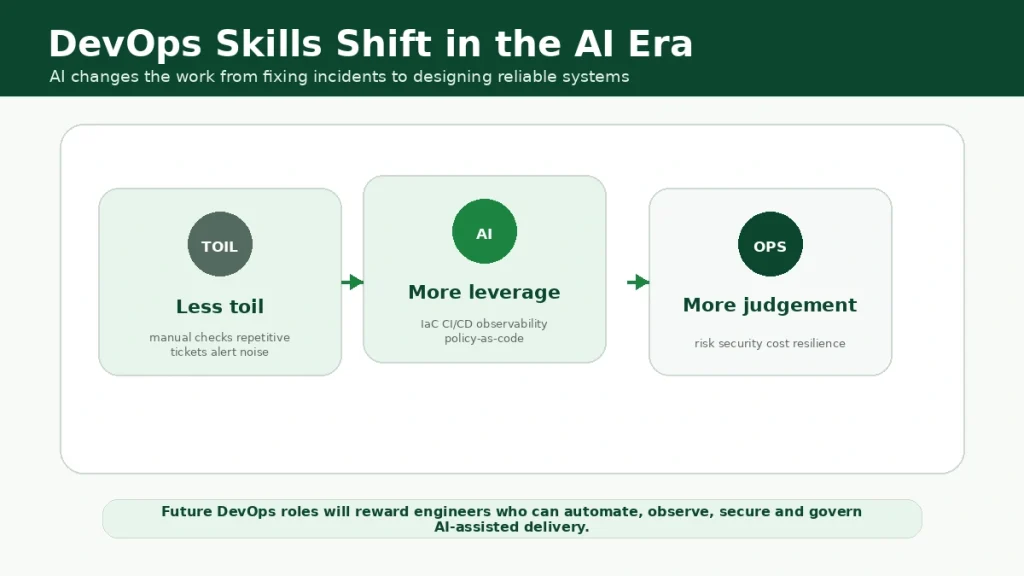
The future is not NoOps, it is smarter Ops. AI will reduce repetitive work, but it will increase the value of engineers who can think across systems.
Skills DevOps Professionals Need in the AI Era
The DevOps professional of the future needs both traditional DevOps skills and AI-aware thinking.
Important technical skills include:
- Cloud platforms such as AWS, Azure and Google Cloud
- Linux and cloud infrastructure administration
- CI/CD pipelines
- Git and GitHub
- Docker
- Kubernetes
- Terraform
- Ansible
- Python for automation
- Monitoring and observability
- Infrastructure as code
- Security and compliance
- Cost optimisation
- AI and machine learning fundamentals
- GenAI-assisted engineering
These skills match many areas covered in the DevOps and Cloud Computing with AI course from Digital Regenesys, which includes cloud foundations, DevOps workflows, automation, CI/CD, containerisation, orchestration, infrastructure as code and AI-driven cloud integration. But technical skills are not enough.
AI-integrated DevOps also needs human skills:
- Critical thinking
- Troubleshooting
- Communication
- Risk judgement
- Collaboration
- Documentation
- Systems thinking
- Security mindset
- Continuous learning
- Ability to challenge AI outputs
The future DevOps engineer will not only ask, “Can this be automated?” They will ask, “Should this be automated, under what conditions, and who is accountable if it fails?”
DevOps Jobs That AI Will Influence
AI integration will affect many DevOps-related roles.
Possible future-facing roles include:
- DevOps Engineer
- Cloud Engineer
- Site Reliability Engineer
- Platform Engineer
- DevSecOps Engineer
- AIOps Engineer
- Cloud Automation Engineer
- Infrastructure Engineer
- Kubernetes Engineer
- Release Engineer
- Cloud Operations Specialist
- AI Operations Analyst
- SRE Automation Specialist
- Platform Product Engineer
- Cloud Security Engineer
Some of these roles already exist. Others are emerging as companies adopt AI more deeply. The biggest shift will not only be in job titles. It will be in expectations.
Employers will increasingly look for people who can work with automated delivery systems, AI-assisted monitoring, cloud platforms and security-integrated pipelines.
A DevOps engineer who only knows manual deployment will fall behind. A DevOps engineer who understands cloud automation, observability, AI-assisted troubleshooting and governance will be far more valuable.
Turn Data Skills Into Career Growth
Learn Python, machine learning & Power BI with hands-on, AI-enabled projects.
Explore ProgrammeHow AI Will Change Entry-Level DevOps Careers
AI may make entry-level DevOps both easier and harder. It may be easier because AI tools can explain errors, suggest commands, summarise documentation and help beginners understand complex workflows.
It may be harder because employers may expect junior professionals to produce more value sooner. This means learners need more than theory. They need projects.
A strong beginner should be able to show evidence such as:
- A CI/CD pipeline
- A deployed cloud application
- A Dockerised project
- A basic Kubernetes deployment
- A Terraform configuration
- A monitoring dashboard
- A simple automation script
- A security scan report
- A cloud cost optimisation example
- An AI-assisted incident response workflow
This is why hands-on learning matters so much. Digital Regenesys positions its DevOps and Cloud Computing with AI course around practical cloud environments, automation workflows and real-world projects, which is useful for learners who need proof of skill, not only knowledge.
Benefits of AI Integration in DevOps
AI can improve DevOps in several ways.
- It can reduce alert fatigue by grouping related incidents.
- It can improve deployment confidence by identifying risky changes.
- It can reduce toil by automating repetitive tasks.
- It can support faster incident response by summarising logs and past fixes.
- It can help teams manage cloud costs.
- It can improve security by scanning earlier and prioritising vulnerabilities.
- It can support developers through better internal platforms.
- It can help teams learn from incidents faster.
The strongest benefit is not speed alone. The strongest benefit is better feedback. DevOps improves when teams learn faster from the system. AI can make that feedback clearer and more useful.
Risks of AI in DevOps
AI also brings risks.
- The first risk is over-automation. Not every action should be automated, especially in production systems.
- The second risk is false confidence. AI can suggest a fix that looks correct but creates a bigger problem.
- The third risk is weak governance. If teams do not track what AI changed, they may struggle to audit decisions.
- The fourth risk is security exposure. AI tools may interact with code, logs, credentials or sensitive infrastructure information.
- The fifth risk is tool sprawl. Teams may adopt many AI tools without a clear platform strategy, creating more complexity rather than less.
- The sixth risk is skill decay. If engineers rely on AI without understanding the fundamentals, they may lose the ability to troubleshoot deeply.
The answer is not to avoid AI. The answer is to govern it properly.
What Good AI-Integrated DevOps Looks Like
A strong AI-integrated DevOps environment has a few clear traits.
- It has reliable pipelines.
- It has strong automated testing.
- It has observability across logs, metrics and traces.
- It uses infrastructure as code.
- It includes security checks early.
- It has clear approval rules.
- It tracks AI-assisted actions.
- It protects sensitive data.
- It uses platform engineering to reduce developer friction.
- It measures delivery performance and developer experience.
- It treats AI as part of the system, not as a shortcut around good engineering.
This is the kind of DevOps future worth building.
How to Prepare for the Future of DevOps with AI Integration
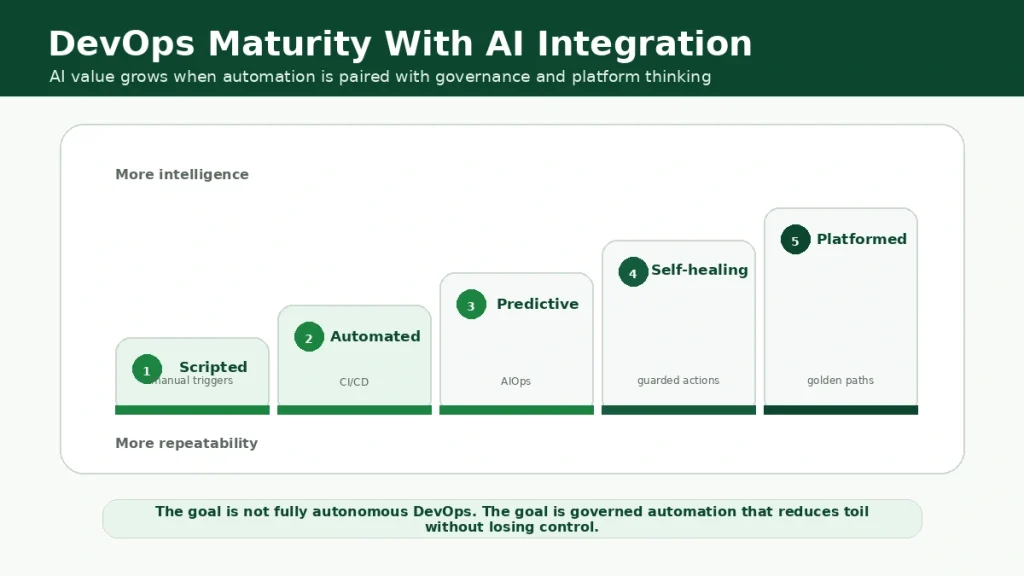
Start with cloud fundamentals. Then build DevOps foundations: Git, Linux, CI/CD, Docker, Kubernetes, automation and monitoring.
Next, learn infrastructure as code with tools such as Terraform and Ansible.
After that, add AI literacy. Understand how AI can support development, operations, monitoring and incident response.
Then learn governance. This includes security, compliance, approvals, documentation and risk management.
The DevOps and Cloud Computing with AI course from Digital Regenesys is a relevant pathway because it brings cloud, DevOps, automation and AI integration together in one learning route.
Learners who want to strengthen adjacent skills can also explore Artificial Intelligence, Cybersecurity with AI, Full Stack Development with AI and Data Science with AI.
Common Mistakes to Avoid
- The first mistake is thinking AI will replace DevOps fundamentals. It will not.
- The second mistake is automating broken processes. Automation makes good processes faster. It makes bad processes more dangerous.
- The third mistake is trusting AI-generated scripts without review.
- The fourth mistake is ignoring security and compliance.
- The fifth mistake is adopting too many tools without platform thinking.
- The sixth mistake is forgetting the human side of DevOps. Culture, communication and ownership still matter.
- The seventh mistake is learning only tools instead of systems.
The future DevOps professional must understand how everything connects.
Next Data Science Batch Starts Soon
Join 500,000+ alumni. Real projects, AI workflows, IITPSA-accredited certificate.
Enrol NowDevOps Will Belong to Engineers Who Can Automate Without Losing Control
The future of DevOps with AI integration is not about removing people from software delivery. It is about removing unnecessary friction from software delivery. AI can help teams detect problems faster, predict risks, reduce toil and improve the feedback loop between development and operations. But it cannot replace accountability, engineering discipline or human judgement.
The best DevOps professionals will be the ones who understand both sides of the equation. They will know how to automate. They will also know when not to.
For learners who want to prepare for this future, the DevOps and Cloud Computing with AI course from Digital Regenesys offers a practical route into cloud platforms, automation, CI/CD, infrastructure as code and AI-assisted engineering.
That is where DevOps is heading: not just faster pipelines, but smarter, safer and more governed delivery.
Last Updated: 17 July 2026