Rethinking Intelligence in the Age of AI: When Intelligence Becomes Abundant, What Makes Us Indispensable?

Not long ago, I watched a student complete in minutes what would once have taken hours. A research summary was generated, a presentation was drafted, and a block of Python code was written—all with the assistance of generative AI.
My first reaction was not surprise. AI has become remarkably capable.
My second reaction, however, was more important.
The real value was not in how quickly the work had been produced. It was in what happened next. The student began questioning the AI’s recommendations, identifying inconsistencies, refining the explanation, and connecting the ideas to concepts discussed in class. The technology accelerated the process, but the learning emerged through reflection, judgment, and dialogue.
That moment captures what I believe is the defining challenge—and opportunity—of the AI era.
For the past few years, much of the conversation has centred on a single question: Will AI replace humans?
History suggests we should ask a different one.
What becomes uniquely valuable when intelligence becomes abundant?
A Personal Reflection
As an educator, I have witnessed this transformation unfold in real time. A few years ago, students would spend hours searching for information, struggling to connect concepts and articulate their understanding. Today, many arrive with AI-generated summaries, explanations, and even code examples already in hand.
At first, this shift seemed to redefine what it meant to teach. If information is available within seconds, what becomes the role of an educator?
Over time, I realised that my role had not become smaller—it had become more meaningful. My responsibility was no longer centred on delivering information alone, but on helping students question assumptions, evaluate evidence, recognise limitations, and apply knowledge with confidence and integrity.
Some of the most rewarding classroom moments no longer come from students producing the “right” answer. They come from the discussions that follow—when they challenge an AI-generated response, identify what is missing, connect ideas across disciplines, or ask questions that neither a textbook nor an algorithm could have anticipated.
Those moments remind me that education has never been solely about transferring knowledge. It has always been about developing judgment, curiosity, and the confidence to think independently. AI has not changed that purpose; if anything, it has made it even more important.
Every Technological Revolution Redefines Human Value
Technological progress has always reshaped work.
The printing press transformed access to knowledge. Calculators changed how mathematics was practised. The internet democratised information. Smartphones placed an extraordinary amount of computing power into our pockets.
Each innovation sparked concern that human expertise would become less relevant.
Instead, expertise evolved.
The role of accountants changed with spreadsheets. Doctors became more effective through medical imaging. Engineers advanced with computer-aided design. Teachers adopted digital learning environments.
Technology rarely removes the need for human capability. More often, it shifts where human capability creates the greatest impact.
Artificial intelligence represents the next chapter in this ongoing story.
Rather than diminishing our value, AI is encouraging us to redefine it.
From Information to Judgment
For much of modern education, success was closely associated with acquiring knowledge. Students were rewarded for remembering facts, professionals for mastering information, and organisations for building expertise.
Today, knowledge is no longer scarce.
With a well-crafted prompt, AI can retrieve, summarise, compare, translate, generate, and explain information within seconds.
This changes the nature of expertise.
When access to information becomes universal, competitive advantage moves elsewhere.
It moves towards judgment.
Judgment enables us to evaluate evidence, recognise uncertainty, understand context, balance competing priorities, and make decisions that extend beyond data alone.
AI can produce multiple possible answers.
Humans decide which answer should guide action.
That distinction is becoming increasingly important across every profession.
The Rise of Human–AI Collaboration
One of the most persistent misconceptions surrounding AI is that it represents a competition between human intelligence and machine intelligence.
In practice, the future looks far more collaborative.
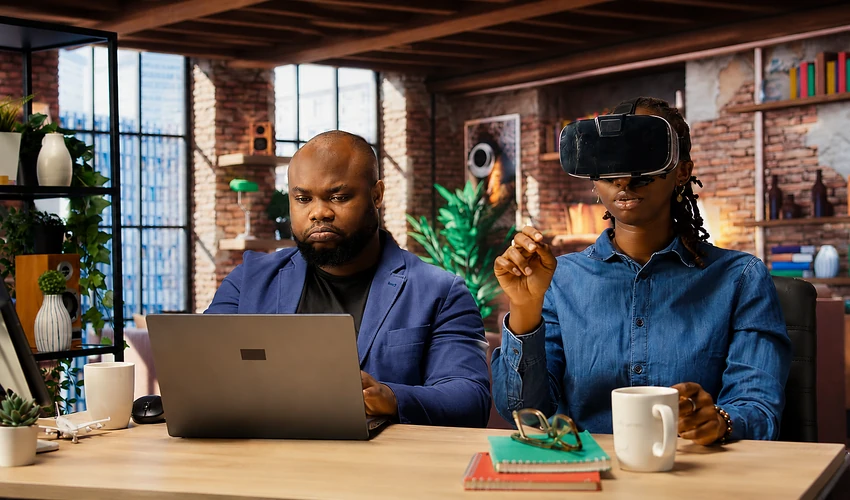
Across industries, professionals are discovering that AI performs exceptionally well as a thinking partner.
Researchers are accelerating literature reviews while dedicating more time to designing meaningful studies.
Software developers automate repetitive coding tasks while focusing on architecture, security, and user experience.
Healthcare professionals use AI-assisted diagnostics while retaining responsibility for clinical reasoning and patient care.
Educators generate learning materials more efficiently, allowing greater attention to mentoring, feedback, and student engagement.
Notice the common thread.
AI is not replacing professional expertise.
It is creating space for deeper expertise.
Routine effort decreases.
Strategic thinking increases.
This may prove to be one of the most significant workplace transformations of our generation.
The Skills That Matter Are Becoming More Human
The Future of Jobs Report 2025 published by the World Economic Forum highlights analytical thinking, resilience, creative thinking, leadership, curiosity, technological literacy, and lifelong learning as among the fastest-growing workforce capabilities.
Interestingly, these are not skills that compete with AI.
They are skills that enable people to use AI effectively.
Similarly, UNESCO’s guidance on generative AI in education argues that learners need more than technical proficiency. They require ethical awareness, critical evaluation, responsible decision-making, and an understanding of AI’s limitations.
This reflects an important shift in perspective.
For years, these capabilities were often described as “soft skills.”
Today, they are becoming strategic skills.
Technical knowledge remains essential.
Human capabilities determine how that knowledge is applied.
Leaders who want to understand how AI can support strategy, judgment and organisational decision-making can explore the AI for Executives Programme at the Regenesys School of AI.
Education Has Entered a New Era
Perhaps nowhere is this transformation more visible than in education.
The question is no longer whether students should use AI.
Many already do.
The more meaningful question is whether they understand how and why they are using it.
If AI can generate an essay, summarise research, solve equations, or explain programming concepts, then education must evolve beyond rewarding reproduction of information.
Learning experiences increasingly need to assess interpretation, application, ethical reasoning, collaboration, creativity, and reflection.
Students should certainly learn how to write effective prompts.
More importantly, they should learn how to challenge AI-generated responses, verify evidence, identify bias, recognise uncertainty, and make informed decisions.
These capabilities prepare graduates not simply to work with AI, but to lead responsibly in an AI-enabled world.
Professionals and learners who want to develop practical, responsible AI skills can explore the AI Fluency Programme at the Regenesys School of AI.
As educators, this may be one of our greatest responsibilities.
Turn AI Curiosity Into a Real Skill
Learn to build real AI models with Python, hands-on projects & live mentor support.
Explore ProgrammeThe New Definition of Expertise
For generations, expertise meant having the answers.
Today, expertise increasingly means asking better questions.
It means recognising when AI offers valuable insight and when human judgment must prevail.
It means understanding that efficiency is valuable, but wisdom is indispensable.
Perhaps the most successful professionals of the future will not be those who know the most.
Nor will they be those who use the most advanced AI tools.
They will be individuals who combine technological fluency with intellectual curiosity, ethical reasoning, empathy, adaptability, and the humility to continue learning.
In many ways, AI is not lowering the value of human intelligence.
It is revealing which dimensions of intelligence have mattered all along.
A Future Worth Building
Artificial intelligence is often described as one of the defining technologies of the Fourth Industrial Revolution.
I believe its greatest contribution may be something less obvious.
It is encouraging us to rethink what it means to be educated, to be skilled, and ultimately, to be human.
Technology can generate information.
Only people can assign meaning.
Technology can improve efficiency.
Only people can define purpose.
Technology can recommend actions.
Only people accept responsibility for the consequences.
The future, therefore, does not belong to humans or to AI.
It belongs to the partnership between them.
Our competitive advantage will not come from resisting intelligent technologies, nor from relying on them unquestioningly.
It will come from cultivating the qualities that allow intelligence—whether human or artificial—to create genuine value.
In an age where intelligence is increasingly abundant, the true measure of intelligence is no longer how much we know.
It lies in our ability to exercise sound judgment, think deeply, act wisely, and use AI in ways that strengthen not only our productivity, but also our humanity.
References
Ethan Mollick. (2024). Co-Intelligence: Living and Working with AI. Portfolio.
Henry A. Kissinger, Eric Schmidt, & Daniel Huttenlocher. (2021). The Age of AI: And Our Human Future. Little, Brown and Company.
UNESCO. (2023). Guidance for Generative AI in Education and Research.
World Economic Forum. (2025). The Future of Jobs Report 2025.
OECD. (2023). OECD Digital Education Outlook 2023: Towards an Effective Digital Education Ecosystem.
Seth, N. (2025). Human edge in the AI age: Eight timeless mantras for success. Penguin Business.
Next AI Batch Starts Soon
Join 500,000+ alumni. Live classes, real projects, IITPSA-accredited certificate.
Enrol NowAbout the Author
Dr. Richa Dhanuka is a Senior Lecturer at Regenesys School of Technology with over 14 years of experience spanning academia and industry. She holds a Ph.D. in Computer Science from the National Institute of Technology (NIT) Patna and specializes in artificial intelligence, machine learning, deep learning, and software development. Her research has been published in leading SCI-indexed journals, including IEEE Transactions on Computational Biology and Bioinformatics and the IEEE Journal of Biomedical and Health Informatics, reflecting her contributions to AI and advanced computing. Dr. Dhanuka is passionate about technology education and enjoys helping students connect classroom learning with real-world applications through hands-on, practical experiences. Her current work explores how artificial intelligence is reshaping education, expertise, and the future of human learning.
Last Updated: 28 July 2026