Mathematics for Artificial Intelligence: What Beginners Need Before Learning AI

Artificial intelligence may seem highly technical when you first encounter concepts such as machine learning, neural networks, algorithms and data models. This can leave beginners wondering whether they need advanced mathematics, programming experience or a technical degree before they can start learning AI.
The answer depends on how deeply you want to go.
You do not necessarily need advanced technical knowledge to begin understanding artificial intelligence. Beginner-level AI learning can start with basic concepts and practical applications. However, if your goal is to build machine learning models, work with data or move into technical AI roles, a stronger foundation in mathematics and programming becomes increasingly valuable.
For learners who want a structured introduction, the Digital Regenesys Artificial Intelligence Course combines introductory AI concepts with practical learning in Python, data preparation, machine learning and model development.
Understanding the right prerequisites can therefore help you avoid feeling overwhelmed and give you a clearer path into AI.
Do You Need Prerequisites Before Learning Artificial Intelligence?
There is no single list of prerequisites that applies to every AI learner.
Someone who wants to understand how generative AI tools work does not need the same technical foundation as someone who wants to become a machine learning engineer.
For introductory learning, basic computer literacy, curiosity and logical thinking may be enough to get started.
For more technical AI and machine learning study, useful foundations typically include:
- Basic mathematics
- Algebra
- Probability and statistics
- Linear algebra
- Basic programming
- Python
- Data literacy
- Logical and analytical thinking
Google’s Machine Learning Crash Course prerequisites recommend familiarity with algebra, linear algebra, statistics and Python for learners who want to complete practical machine learning exercises.
However, beginner AI programmes can be much more accessible. Microsoft, for example, offers introductory AI learning with no prerequisites, demonstrating that beginners can start with core AI concepts before moving into more technical topics.
Why Is Mathematics Important for Artificial Intelligence?
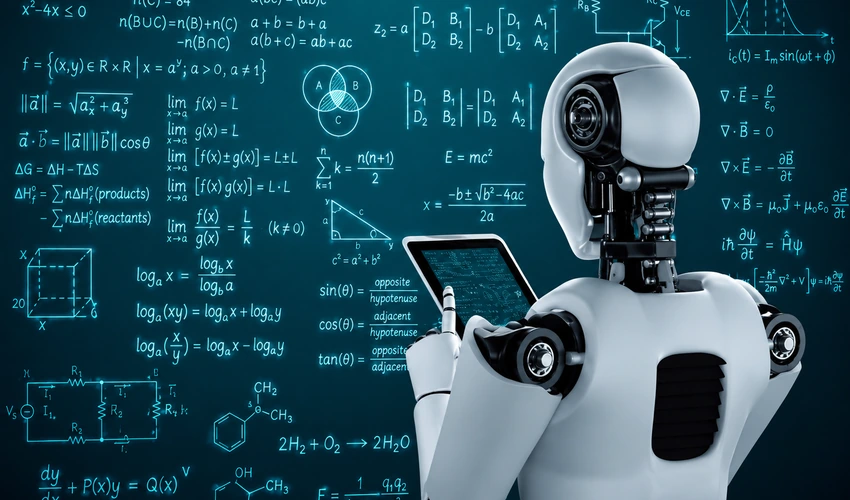
Mathematics for artificial intelligence provides the foundation for how AI systems process data, identify patterns and make predictions.
AI models do not simply make decisions on their own. They rely on mathematical relationships, probabilities, optimisation techniques and numerical calculations.
That does not mean every beginner must become a mathematician before learning AI.
The level of mathematics you need depends on what you want to do.
If you are learning how to use AI tools, you may need very little mathematics. If you plan to develop machine learning models or work in AI engineering, understanding the mathematical foundations becomes more important.
What Mathematics Do You Need for Artificial Intelligence?
1. Basic Algebra
Algebra is one of the most useful mathematical foundations for AI.
Machine learning models often use equations to represent relationships between variables. Understanding basic algebra helps you work with:
- Variables
- Functions
- Equations
- Graphs
- Exponents
- Logarithms
You do not need advanced algebra to begin. Being comfortable working with simple equations and understanding how variables relate to one another can make machine learning concepts easier to follow.
2. Linear Algebra
Linear algebra becomes important when AI systems work with large amounts of data.
It deals with mathematical concepts such as:
- Vectors
- Matrices
- Tensors
- Matrix multiplication
AI systems frequently represent data as numerical arrays. Images, text embeddings and machine learning datasets can all be represented mathematically using vectors or matrices.
This is why linear algebra is commonly considered one of the core mathematical foundations of machine learning.
3. Probability
Artificial intelligence often deals with uncertainty.
A model may not say that something is definitely true. Instead, it may calculate the likelihood of a particular outcome.
Probability helps AI systems make these estimates.
For example, an email filter may calculate the probability that a message is spam. A recommendation system may estimate the likelihood that a user will be interested in a particular product or movie.
Understanding probability can therefore help learners understand how AI models make predictions under uncertainty.
4. Statistics
Statistics helps AI learners understand and interpret data.
Useful beginner concepts include:
- Mean
- Median
- Standard deviation
- Distributions
- Correlation
- Sampling
Machine learning models depend heavily on data, so learners need to understand what data represents and how to identify meaningful patterns.
Statistics also helps learners recognise when data may be incomplete, misleading or biased.
5. Calculus
Calculus is useful in more advanced machine learning but is not always necessary when you first start learning AI.
Machine learning algorithms use concepts such as derivatives and gradients to improve model performance during training.
For example, gradient descent is used to adjust model parameters so that predictions become more accurate.
Google describes calculus as optional for some of the more advanced sections of its Machine Learning Crash Course, which means beginners can start learning important AI concepts before mastering calculus.
Do You Need Python to Learn Artificial Intelligence?
Python is one of the most commonly used programming languages in artificial intelligence and machine learning.
This is partly because its syntax is relatively approachable and because it has a large ecosystem of libraries designed for data analysis, machine learning and AI.
Common Python libraries used in AI include:
- NumPy
- Pandas
- Scikit-learn
- TensorFlow
- PyTorch
However, beginners do not need advanced Python expertise before starting.
Basic programming concepts are often enough initially. These include:
- Variables
- Data types
- Conditions
- Loops
- Functions
- Lists and dictionaries
As your AI learning becomes more technical, your Python skills can develop alongside it.
If you are still deciding how to begin your learning journey, our guide on how to learn artificial intelligence explores different learning pathways, including online courses, certifications and practical study options.
Why Is Data Literacy Important for Learning AI?
Artificial intelligence depends on data.
Models learn from examples, patterns and information contained within datasets.
This means learners should gradually become comfortable working with data.
Useful data skills include:
- Understanding rows and columns
- Identifying missing information
- Recognising patterns
- Cleaning datasets
- Interpreting charts and graphs
- Understanding structured and unstructured data
These skills become particularly important when learners begin working with machine learning.
A technically advanced model cannot compensate for poor-quality data. Understanding how data is collected, prepared and interpreted is therefore a core AI skill.
Do You Need Machine Learning Knowledge Before Learning AI?
No. Machine learning knowledge does not need to come before artificial intelligence learning.
Machine learning is one area within the broader field of AI.
A beginner can first learn what artificial intelligence is, where it is used and how different AI systems work before exploring machine learning in more detail.
Useful concepts to understand progressively include:
- Artificial intelligence
- Machine learning
- Deep learning
- Neural networks
- Natural language processing
- Computer vision
- Generative AI
For a broader introduction, read our beginner’s guide to artificial intelligence, which explains the fundamentals, types and applications of AI.
What Non-Technical Skills Are Required for Artificial Intelligence?
AI learning is not only about mathematics and programming.
Several non-technical abilities can also help learners succeed.
Turn AI Curiosity Into a Real Skill
Learn to build real AI models with Python, hands-on projects & live mentor support.
Explore ProgrammeProblem-Solving
AI is often used to solve practical problems.
Strong problem-solving skills help learners break larger challenges into smaller steps and decide which tools or methods may be suitable.
Logical Thinking
Programming and algorithms rely on clear sequences and rules.
Logical thinking helps learners understand how inputs lead to outputs and how different parts of an AI system interact.
Curiosity
AI changes quickly.
Learners who are willing to experiment, ask questions and explore new tools may find it easier to adapt as technology evolves.
Critical Thinking
AI systems can produce inaccurate or biased results.
Critical thinking helps learners evaluate outputs rather than automatically assuming that an AI system is correct.
Communication
AI professionals often need to explain technical results to colleagues, customers or decision-makers who may not have a technical background.
Being able to translate technical ideas into clear language is therefore valuable.
Can You Learn Artificial Intelligence Without a Technical Background?
Yes.
A non-technical background does not automatically prevent someone from learning artificial intelligence.
The right starting point depends on your goal.
If you want to understand AI concepts or use AI in business, marketing, education or another professional field, you may begin without coding or advanced mathematics.
If you later decide to move into AI development, machine learning or data science, you can progressively build your mathematics and programming foundations.
This gradual approach can make AI more accessible than trying to master every prerequisite before starting.
Digital Regenesys also provides guidance on AI course requirements in South Africa, including the types of technical and academic foundations that may help learners prepare for AI study.
What Is the Best Order for Learning Artificial Intelligence?
A beginner-friendly learning path can look like this:
- Understand what artificial intelligence is.
- Learn basic computer and data concepts.
- Strengthen basic algebra and statistics.
- Learn beginner Python programming.
- Understand machine learning concepts.
- Learn basic linear algebra.
- Work with simple datasets.
- Build beginner machine learning projects.
- Explore deep learning and neural networks.
- Move into specialised AI areas such as NLP or computer vision.
This approach allows mathematics, programming and AI concepts to develop together rather than treating them as completely separate subjects.
How Much Mathematics Do You Really Need Before Starting AI?
You do not need to master all of mathematics for artificial intelligence before you begin learning.
For introductory AI, basic computer literacy and an understanding of simple mathematical concepts can be enough.
As you progress into machine learning, it becomes helpful to strengthen:
- Algebra
- Linear algebra
- Probability
- Statistics
Calculus becomes more relevant when studying advanced machine learning algorithms and neural networks.
The most practical approach is therefore to learn mathematics alongside AI rather than postponing your AI journey until you feel you have mastered every mathematical topic.
How Can Beginners Start Learning Artificial Intelligence?
The first step is to decide what you want AI knowledge to help you achieve.
If your goal is general AI literacy, you can begin with introductory concepts and practical AI tools.
If your goal is a technical career, you can gradually build stronger skills in mathematics, programming and data.
A practical roadmap can include:
- Start with introductory AI concepts.
- Practise basic mathematics regularly.
- Learn beginner Python.
- Work with simple datasets.
- Complete small AI or machine learning projects.
- Build towards more advanced topics gradually.
Structured learning can help connect these different foundations. The Digital Regenesys Artificial Intelligence Course is designed to move learners through introductory, intermediate and advanced AI concepts while building practical skills in Python, data and machine learning.
Learners who want to compare broader options can also explore Digital Regenesys online technology courses to identify a learning path aligned with their goals.
Next AI Batch Starts Soon
Join 500,000+ alumni. Live classes, real projects, IITPSA-accredited certificate.
Enrol NowBuilding the Right Foundation for Artificial Intelligence
Learning artificial intelligence does not require you to know everything before you begin.
The most important requirement is a willingness to build your knowledge progressively.
For beginners, basic mathematics, logical thinking and computer literacy can provide a useful starting point.
As your learning becomes more technical, you can strengthen your understanding of algebra, statistics, probability, linear algebra and Python.
Rather than seeing these prerequisites as barriers, it is more useful to see them as skills that develop alongside your AI journey.
A strong foundation in mathematics for artificial intelligence, programming and data can ultimately help you understand not only how AI tools are used, but why they work.
Last Updated: 7 August 2026