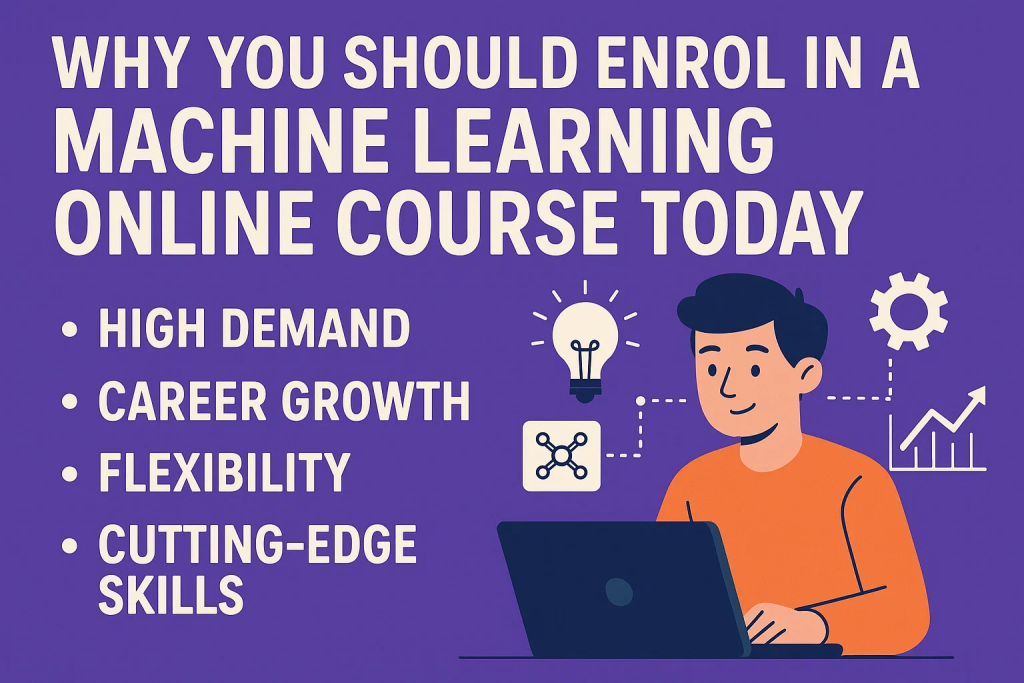
Why You Should Enrol in a Machine Learning Online Course Today

Machine learning (ML) is no longer a futuristic concept; it is shaping the present. From powering virtual assistants and recommendation systems to optimising supply chains and transforming healthcare, ML is everywhere.
Organisations are rapidly adopting ML to remain competitive, creating a surge in demand for professionals who can understand and apply these technologies.
Yet, while the demand is accelerating, the talent gap remains significant. Those who act now can position themselves at the forefront of this technological revolution.
In this article, we’ll explore why enrolling in a machine learning online course today can transform your career, the skills you’ll gain, and why waiting might mean missing out on unparalleled opportunities.
The Rising Demand for Machine Learning Talent Across Industries
Machine learning skills are not confined to tech companies. Industries across the spectrum are deploying ML to solve pressing challenges.
Finance companies use ML for fraud detection and risk analysis; retailers leverage it for personalised recommendations; logistics firms use predictive analytics for inventory management; and healthcare providers rely on ML for medical imaging and patient outcome predictions.
The World Economic Forum predicts that AI and ML will create millions of new roles globally in the coming years. Employers now actively seek professionals who can combine technical expertise with business acumen to derive insights and build intelligent systems.
As industries rush to adopt machine learning, online learning has emerged as the fastest way for individuals to stay current with the latest developments.
- Finance: Predicting credit risks and fraud prevention
- Retail: Personalised product recommendations
- Healthcare: AI-assisted diagnosis and drug discovery
- Manufacturing: Predictive maintenance and process optimisation
- Marketing: Customer segmentation and campaign automation
Discover information on the AI and Machine Learning Course.

Why Online Learning Has Become the Fastest Path to ML Skills
Traditional education paths, while valuable, often take years to complete and may not reflect the pace at which technologies like ML evolve. Online learning, by contrast, offers immediate access to industry-relevant skills, with the flexibility to fit into busy schedules.
Whether you are a student seeking to future-proof your career or a professional looking to upskill without disrupting your work commitments, online machine learning courses make high-quality training accessible globally.
Here’s why more learners are choosing online ML courses:
- Flexibility to learn anytime, anywhere
- Cost-effective compared to traditional degrees
- Updated curriculum aligned with industry demands
- Access to diverse resources, tools, and global networks
Real-World Problems Solved by Machine Learning
One of the most compelling reasons to study ML is its real-world impact. Businesses and organisations are using ML to tackle challenges once thought unsolvable.
For instance, in healthcare, ML models assist doctors by detecting anomalies in X-rays faster than human eyes. In e-commerce, recommendation algorithms drive sales by suggesting products tailored to customer behaviour. In logistics, predictive modelling ensures efficient delivery routes, saving millions in operational costs.
By learning ML today, you can contribute to solutions in areas such as:
- Fraud detection in banking and fintech
- Climate change modelling and sustainability efforts
- Smart city planning and traffic management
- AI-driven chatbots are improving customer service
- Precision farming to improve crop yields
Understand the basics of Machine Learning VS Cloud Computing.

Key Advantages of Enrolling Today
The timing of when you learn ML matters. As industries mature, the competition for ML roles intensifies. Early learners benefit from being first movers; they not only gain skills but also experience applying them before the market becomes saturated.
In addition, starting now allows learners to take advantage of rapidly evolving tools, cloud platforms, and open-source frameworks that are driving innovation in ML. Companies are keen to recruit professionals who can demonstrate readiness to experiment with new technologies rather than wait for established standards.
By enrolling today, you position yourself as someone who is adaptive, curious, and ahead of industry trends. This mindset itself is attractive to employers who prioritise agility.
Delaying enrolment could mean missing opportunities to work on innovative projects or securing high-demand roles. Employers value candidates who can demonstrate proactive upskilling and readiness to adapt.
The benefits of enrolling today include:
- Gaining a competitive edge in the job market
- Accessing emerging job roles tied to AI and ML
- Showcasing adaptability and forward-thinking to employers
- Building real-world project experience earlier than peers
Essential Skills You Will Gain from an Online ML Course
An online ML course equips you with both technical and analytical skills. Beyond theory, these courses emphasise applied learning, enabling you to develop practical solutions to real-world problems.
Some of the core skills you’ll gain include:
- Understanding supervised and unsupervised learning
- Building regression, classification, and clustering models
- Developing neural networks and AI-driven solutions
- Data preprocessing, cleaning, and feature engineering
- Model evaluation, optimisation, and deployment
Turn Data Skills Into Career Growth
Learn Python, machine learning & Power BI with hands-on, AI-enabled projects.
Explore ProgrammeThe Role of Machine Learning in Career Growth
Automation is reshaping industries, and many traditional jobs are at risk of being replaced. However, machine learning expertise is one of the few skills that remains resilient. Instead of being automated, ML professionals are the ones building the automation.
Consider roles in marketing or finance where repetitive tasks, such as data entry, reporting, or customer query resolution, are being increasingly automated. Professionals who lack technical expertise risk being sidelined.
In contrast, those with ML knowledge not only remain relevant but also play a central role in designing and improving these intelligent systems. This creates an opportunity to move from being a consumer of automation to becoming its architect.
ML knowledge also benefits professionals beyond data science roles. Marketing teams use ML to analyse consumer data; HR departments apply predictive analytics in recruitment; and healthcare workers rely on ML-powered tools.
By mastering ML, professionals can:
- Safeguard careers against automation risks
- Transition into emerging, future-ready roles
- Apply AI-driven insights to enhance decision-making
- Increase value across diverse industries
Comparing Self-Taught Learning vs Structured Online Courses
Some learners attempt to pick up ML skills independently through free resources. While this approach can be effective, it often leads to fragmented knowledge and a lack of direction. Structured online courses, on the other hand, provide a guided pathway from fundamentals to advanced topics, ensuring learners build competence systematically.
Here’s why structured courses provide an edge over self-taught learning:
- Clear curriculum progression from basics to advanced topics
- Hands-on projects using real-world datasets
- Mentorship and instructor feedback
- Recognised certifications that add credibility to CVs
How Online Machine Learning Courses Build Practical Confidence
Theory alone is not enough in machine learning; application matters most. Online courses often incorporate practical projects that require learners to apply algorithms to real data. This experience is invaluable; it not only reinforces learning but also provides a portfolio to showcase to employers.
Practical learning in ML courses enables learners to:
- Work on real-world datasets
- Develop a portfolio of projects for interviews
- Apply algorithms to solve industry challenges
- Gain confidence in transitioning from theory to practice
Why Combining ML with a Data Science Pathway Creates an Edge
While ML is powerful on its own, it is often part of the broader data science field. Pursuing a data science pathway equips learners not only with ML but also with programming, statistics, and business analytics.
This integrated knowledge makes professionals versatile. They can work across various roles, including analytics, AI, business intelligence, and engineering. A data science course that incorporates ML ensures a holistic skill set for tackling both current and future challenges.
With a data science pathway, you can:
- Learn programming, visualisation, and advanced analytics
- Integrate ML into end-to-end data science workflows
- Broaden your career opportunities across industries
- Demonstrate a holistic understanding of data-driven decision-making

Next Data Science Batch Starts Soon
Join 500,000+ alumni. Real projects, AI workflows, IITPSA-accredited certificate.
Enrol NowConclusion
The demand for machine learning expertise is growing at an unprecedented pace. Enrolling in an online ML course today means positioning yourself ahead of the curve, gaining future-ready skills, and opening doors to industries that rely on intelligent systems.
The Digital Regenesys Data Science Certificate Course not only equips learners with machine learning expertise but also provides a comprehensive toolkit for data science. It combines theory with practical projects, preparing professionals for success in dynamic industries.
Visit Digital Regenesys today and take the first step towards mastering machine learning and data science for your future career.
Last Updated: 6 November 2025